

Simulation Timing Records: Sensor Rate and Physics Step
2026-11-04
Simulation Timing Records: Sensor Rate and Physics Step
Simulation Timing Records should explain what each timing field describes before a learner compares its value with another setting. A sensor's data-generation rate and a physics time-step field can appear in the same training package, yet they concern different parts of the simulation description. Calling both “simulation speed” hides that distinction. This article reads SDFormat 1.12 definitions in the sdf16 repository branch. It reviews a fictional learning package without selecting values, tuning a physics engine or running a simulator.
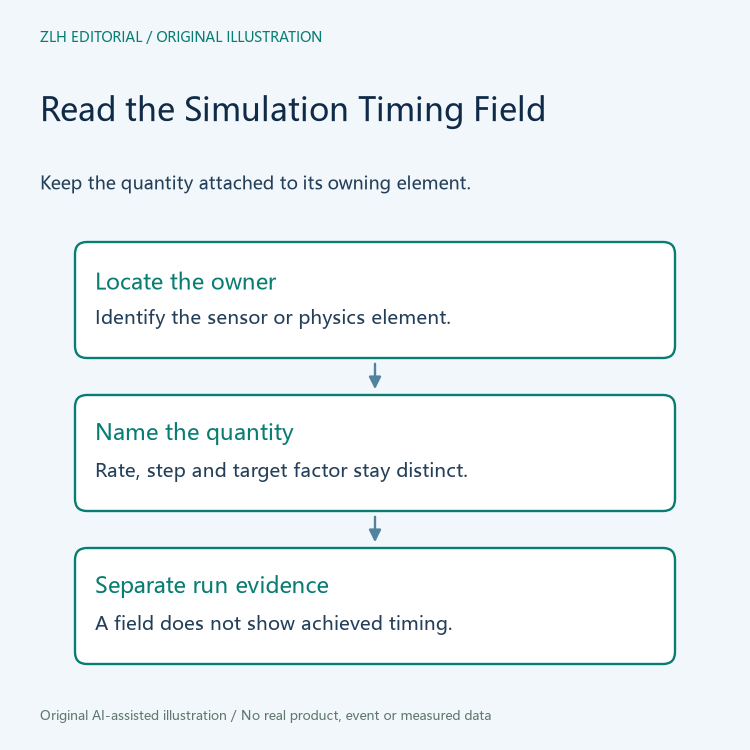
Identify the element that owns the timing field
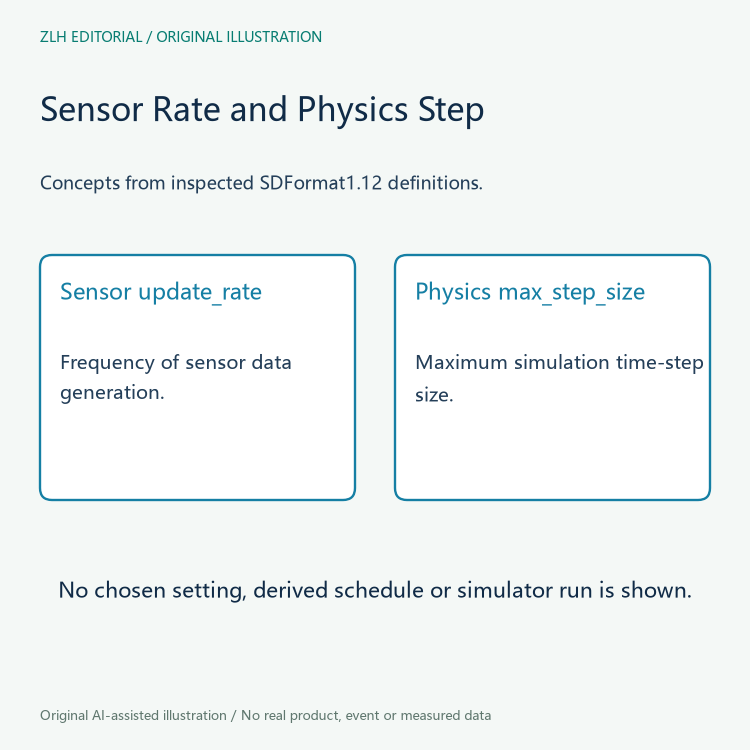
The official sensor definition describes update_rate as the frequency at which sensor data is generated. The field belongs to a sensor description. Retain that owning sensor and the original field name when explaining it in a handover note. A general heading such as “update setting” can become ambiguous when several sensors or other updating systems appear in the same world.
A proposed reading sheet can identify the sensor name, the field location and the contributor's explanation of the intended quantity. If an excerpt omits its enclosing element, ask for enough context to identify the owner. Do not choose the owner from a nearby screenshot or a familiar number. The aim is to explain the supplied description faithfully, rather than to reconstruct missing configuration through the editor's assumptions.
Read a physics time step as its own quantity
The official physics definition describes max_step_size as a maximum simulation time-step size. It is a different field in a different containing element. A frequency statement about sensor data and a maximum time-step statement should therefore keep their distinct quantity names in the reading record.
This article makes no reciprocal calculation and derives no schedule from the two fields. Understanding that the fields differ is useful even when their actual submitted values are unknown. If a contributor wants to claim a relationship between them in a particular simulator, ask for that implementation context and supporting account. A schema description alone does not demonstrate the timing behavior of a particular running system.
Keep target descriptions separate from achieved behavior
The physics source also contains a real_time_factor field described as a target ratio of simulation time to real time. Its presence illustrates why “timing” is an umbrella topic rather than one interchangeable quantity. A target speedup factor, a maximum step size and a sensor generation frequency should not be flattened into a single column whose heading gives no indication of which one is being discussed.
A runtime result would need an actual execution account and suitable observations. A model field can help identify a question for that account, but cannot supply the missing run. Avoid writing that a simulator achieved a specified rate merely because the submitted description contains a timing field. Likewise, a clear explanation of the field does not establish that the simulated sensor resembles a real device's temporal behavior.
Review a fictional lesson with one speed column
Imagine a fictional package called Sensor Lesson Iris. Its model excerpt contains a sensor update_rate and a physics max_step_size, while the lesson notes place both under “speed.” No runtime recording accompanies the notes. The documentary ambiguity is which quantity each table entry represents. The reviewer can identify that ambiguity without generating messages, inspecting a live graph or measuring elapsed execution time.
A corrected note should give the two fields separate descriptions and retain their owning elements. If the author also discusses a target real-time factor, provide a third explanation rather than using it as a label for the other two. The correction should show how each note relates to its original field. That makes the lesson easier to follow without turning the review into a parameter-selection exercise.
If a later revision supplies an actual run report, preserve which model revision was used and what the report claims to observe. Do not silently attach a newer report to an older model excerpt and describe them as one unchanged package. A model revision, a wording correction and a runtime observation are separate events. Keeping them identifiable helps another learner understand exactly which question has been answered and which remains open.
Close the terminology issue at the evidence boundary
A useful review conclusion can state that sensor generation frequency, maximum physics step and target speedup are now named separately in the lesson. It can retain an unresolved question about actual scheduling or achieved timing. That is a more precise conclusion than a broad “simulation timing verified” statement, which could imply observations that the review never made.
The site's reference category and related-information category provide further navigation. When a later lesson changes its simulator or source branch, revisit the affected explanations in that context. Preserve the original field meanings and ask for the evidence needed for any additional behavior claim.


