

Simulation Model Acceptance: Read Damping and Friction
2026-11-04
Simulation Model Acceptance: Read Damping and Friction
Simulation Model Acceptance should make a supplied model understandable before anyone describes its motion as realistic. A handover sheet that labels both damping and friction as “joint resistance” may be convenient to scan, but it hides the meaning of the individual fields. The reader needs the exact property, its model location and its stated basis. This exercise uses SDFormat 1.12 definitions in the sdf16 repository branch. It does not tune a simulator, select coefficients or validate a real robot.
Retain the joint and axis around the property name
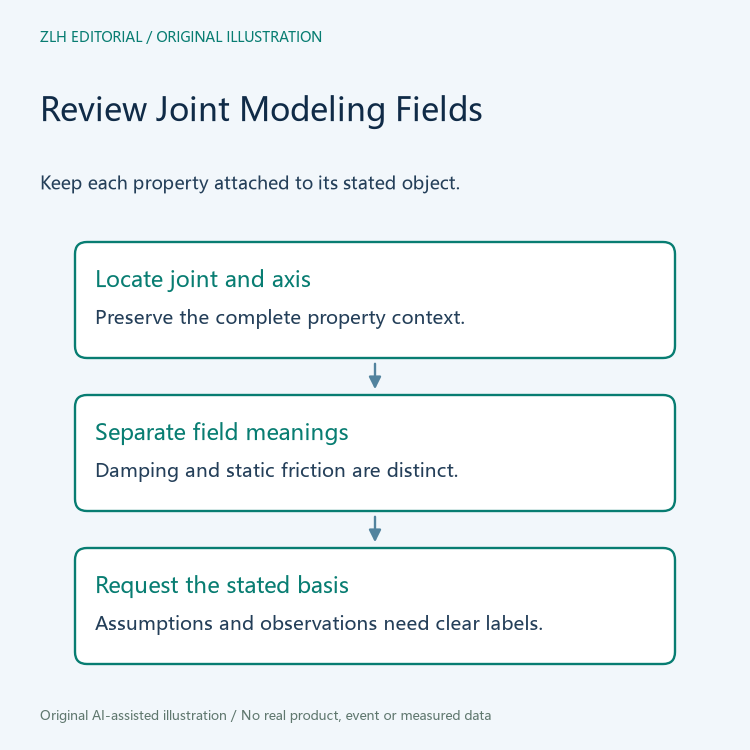
The official SDFormat joint definition places damping and friction within joint-axis dynamics information. It describes damping as a velocity-dependent viscous damping coefficient and friction as a static-friction value. Those descriptions are distinct. A reading note should not erase the difference by replacing both field names with a single broad label.
Start by asking which joint and which axis the handover statement concerns. A property name without its location can be difficult to interpret when a model has several relationships. The proposed review record can retain the original name, the containing model path and the contributor's explanation. This is a documentation convention for discussion, not a substitute for the applicable simulator's own semantics or an assertion that the supplied model has already been parsed successfully.
Ask what supports each supplied modeling value
Once the property has been located, ask the contributor how its value was obtained and what it is meant to represent. A source may be an identified measurement, an explicit modeling assumption or a copied example. Those possibilities require different wording in the record. Do not promote an unexplained number into a manufacturer-confirmed characteristic merely because it appears inside a valid-looking model file.
For an acceptance discussion, it is useful to distinguish “the supplied file contains this field” from “the source of this modeling assumption has been explained.” The first is an observation about a document. The second requires the contributor's account and supporting material. An editor should leave the second question open when no basis has been supplied, rather than choosing a plausible coefficient to make the handover sheet look complete.
Keep link inertia outside the joint-property shorthand
The official inertial definition concerns a link's mass, center-of-mass position and central inertia properties, with additional optional information. This is another model subject. A record that explains joint damping does not thereby explain the link's inertial data. Preserve the containing object when grouping property notes.
This separation helps make follow-up requests specific. If the contributor explains an inertia source, attach that answer to the link information it addresses. Do not use it to close an unrelated question about joint friction. Conversely, a clear explanation of friction should not be described as completing the entire physical-model review. The goal is an intelligible set of supported statements, each attached to the property and object it actually concerns.

Review a fictional handover with one resistance column
Imagine a fictional training model called Arm Rowan. Its handover sheet has one column named “resistance,” while the supplied model excerpt separately contains damping and friction fields. The sheet does not say whether the column summarizes one field, both fields or a different modeling concept. A reviewer can preserve the excerpt and identify this ambiguity without calculating any movement or producing a simulated graph.
The clarification request should name the joint, axis and two original fields. Ask the author to explain the sheet's intended meaning and give each supplied property its own basis. If the author merely changes the column title, check whether the underlying association has become clear. If the author changes model values, preserve the revision as a changed input. A labeling correction and a model change should not be recorded as the same event.
A proposed review sheet can make the explanation concrete by keeping a row for each property, with the owning joint or link, the original supplied text, the claimed source and the unresolved question. These headings do not confer technical validity. They help reveal when one source description has been copied across unrelated fields. If a property is absent from the submitted excerpt, record the absence at that excerpt boundary rather than inventing an explicit value. What a particular parser or simulator then does would require its own implementation context. A later reviewer should be able to distinguish an author-supplied value from an editor's guess.
Accept the explained record without inventing physical validation
A bounded document-acceptance note can state that damping and friction are now identified separately, their source explanations are attached, and a link-inertia question remains open. It should not state that the robot's physical behavior has been reproduced. Such a claim would need an actual comparison, its conditions and suitable evidence beyond this reading exercise.
The site's reference category and related-information category provide further navigation. For later model revisions, return to the exact properties affected and review their explanations again. This keeps the handover useful to another learner without treating a familiar field name, a completed spreadsheet or a schema-shaped file as a measured result about a real machine.


