

Robot Simulation Practice: Read World and Model Scope
2026-11-04
Robot Simulation Practice: Read World and Model Scope
Robot Simulation Practice begins before a learner presses a run button. A delivered folder may contain a robot model, an environment description and other resources, while a handover note calls the entire collection “the model.” That wording makes it difficult to know what another learner should review. Separating world scope from model scope gives the discussion a clearer starting point. The exercise below reads SDFormat definitions; it does not load a scene or operate hardware.
Identify the specification context before naming the object
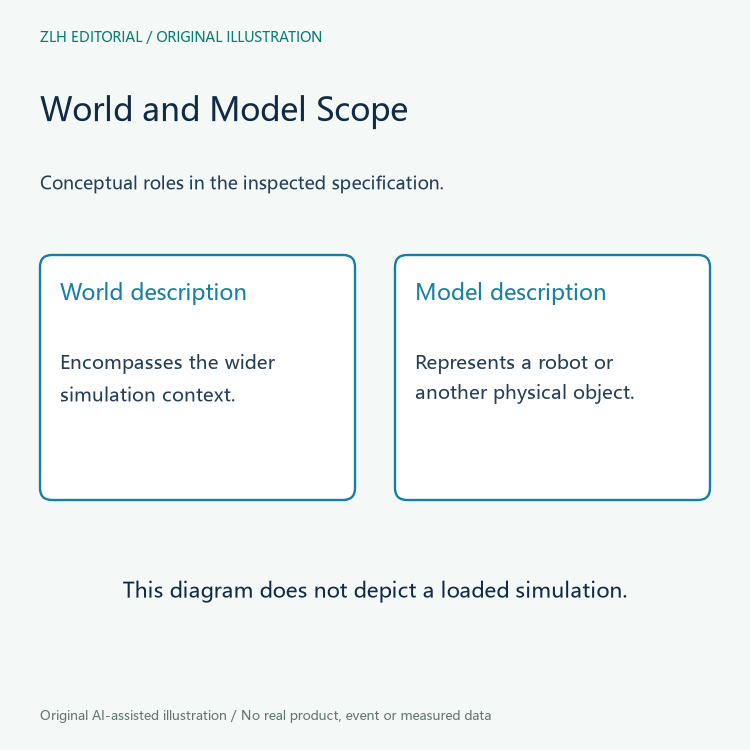
The official world definition for SDFormat 1.12 in the sdf16 branch describes a world as encompassing models, scene, physics and plugins. That scope is broader than a single robot object. Preserve both the specification path and repository branch when citing it, because a specification version and a library release label are different pieces of context.
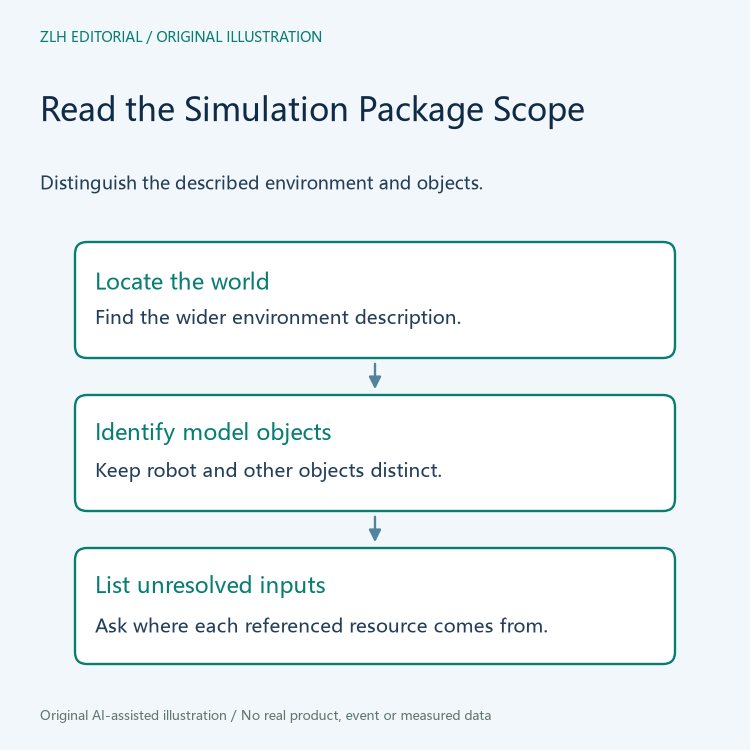
For a proposed reading exercise, start by identifying which supplied document the handover note calls a world. If the package description uses only an informal filename, leave the role unconfirmed until the author explains it or the relevant content is inspected. A promising filename is a discovery clue. It is not enough evidence to state that a particular simulation environment has been fully delivered or successfully reconstructed.
Read model scope as a separate description
The corresponding official model definition describes a complete robot or another physical object. It also includes nested-model structures and resource inclusion. Consequently, “model” should not automatically be read as “robot arm,” nor should every model in a world be assumed to represent the same kind of object. The source defines a representation role, not a verified physical inventory.
A learner can make a short account in ordinary language: which described object is the robot, which objects supply surroundings, and which relationships still require explanation. Keep that account tied to the actual package rather than filling it from a remembered demonstration. If a file is unavailable, mark the missing evidence. The goal is a readable inventory of questions, not a reconstruction built from guesses about what a typical scene ought to contain.
Resource references create questions about the delivered boundary
The inspected definitions describe resource inclusion using URIs. For a handover reader, that raises a practical documentary question: does the package contain the referenced material, or does the provider expect it to be obtained elsewhere? This article proposes asking that question; it does not promise that a URI can be resolved in a given environment or that a resource remains available.
Write the question at the relevant object. An unresolved model resource and an unexplained world setting are different gaps, even if both prevent a learner from understanding the package. Keeping their locations distinct helps the provider respond precisely. A reply that explains where an object comes from should not automatically close a separate question about the surrounding world. Likewise, receiving a missing file is a delivery observation, while a successful scene reconstruction would require its own actual evidence.
Review a fictional package without inventing a run
Imagine a fictional teaching package containing a robot description and a document labeled “training world.” Its readme says that a workbench appears in the lesson, but does not identify whether that object is included in the folder or referenced externally. A reviewer can record the robot description, the claimed world role and the unexplained workbench reference as separate items. No physical workbench or real classroom is implied by this example.
The next request could ask the author to identify the workbench resource and explain its relationship to the world description. It would be premature to report that the scene has a collision problem or that the model format is incompatible. Nothing in the fictional evidence establishes either diagnosis. If the provider later supplies a revised package, retain the earlier question and connect the answer to the particular revision that addresses it.
State what the package review actually established
A bounded review can conclude that the documentation now distinguishes the robot object, other represented objects and their world context. It can also state which references remain unexplained. That conclusion is useful even though it contains no simulated trajectory or performance figure. It tells the next learner what to read and what to request before attempting a separate reproducibility exercise.
The site's reference category and related-information category provide further navigation. They do not certify the contents of any supplied folder. When the exercise moves from documents to an actual simulator, its observations need a new record identifying the files and environment used. Keep that later evidence separate from this reading note, so a clear description of world and model scope is not mistaken for proof that the simulation has already run as intended.


