

MuJoCo 3.17 Batch API: Read the Comparison Scope
2026-11-03
MuJoCo 3.17 Batch API: Read the Comparison Scope
The batch API is a significant feature described in MuJoCo 3.17.0, whose official release entry is dated October 22, 2026. Its documentation gives a specific comparison with serial execution that deserves careful reading. A robot-simulation briefing should preserve the conditions of that statement rather than convert it into a general performance promise. This review runs no simulation and measures neither speed nor physical robot behavior.
Identify the published comparison before interpreting its value
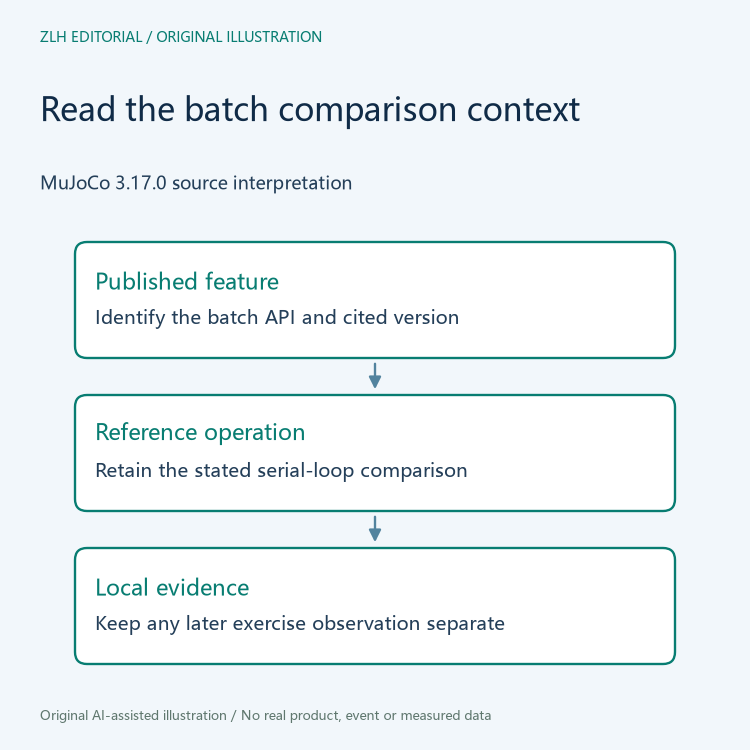
The official 3.17.0 release notes introduce the batch API and describe simulations of one model using a dedicated thread pool. The project reports a bit-identical relationship with the stated serial-loop comparison. That is a project statement with an identifiable reference operation.
A reader should first ask what is being compared. Numerical agreement with a defined loop and reduced elapsed time are different questions. A software feature can address one without the reader possessing evidence for the other. Preserve that distinction when summarizing the release.
The release date should also remain visible. This is a review of the cited October material, not an assertion that the feature was announced today. No local installation is examined, so the article does not claim that a particular learning environment already uses this version. Ask the lesson owner which implementation its actual instructions concern before comparing a future classroom observation with the documented feature.
Read the simulation-state model in the accompanying documentation
The official simulation documentation explains a batch holding simulation states in rows and loading them into working data for calls. It also distinguishes derived outputs from the stored integration state. That gives a reader a more precise vocabulary than many robots running at once.
A simulation in this context is a software state and computation. It should not be described as a physical robot participating in a real experiment. The owner of a later learning exercise still needs to explain the model, inputs, and intended observations.
Keep a source diagram separate from an implemented architecture. An editorial illustration can organize the documented concepts without showing the internal structure of a reader’s application. It must not acquire an execution history merely because its labels resemble an API.
Do not widen the stated agreement into every reproducibility claim
The documented comparison identifies a particular serial reference and threading context. It should not be silently extended into a guarantee about all software versions, platforms, models, or user callbacks. A broader claim would need the relevant evidence and clearly identified conditions.
A proposed learning review can ask which reference operation the author intends to reproduce. That makes an agreement question concrete. An animation looking similar is a different observation from a defined numerical comparison, and neither should be invented to complete the exercise report.

The present article supplies no state arrays, callback results, trajectories, or comparison output. The documentation describes behavior; it is not a test conducted by this publication. A later authorized exercise should retain its actual inputs and observed scope.
Keep speed and resource questions independently reviewable
A batch interface can motivate questions about time or memory without answering them for every application. Ask the exercise author what workload and resource context a proposed measurement concerns. The reader should not attach an invented acceleration factor to the presence of a thread pool.
Likewise, a project explanation of storage does not establish the memory use of an unspecified experiment. A real report would need the actual setup and measurement method. This review provides neither numerical expectations nor a claimed resource improvement for a delivered training package.
Retain boundaries when moving from documents to an exercise
Before a separate authorized review, identify the model, implementation version, intended comparison, and evidence to retain. Keep the proposed activity distinct from an executed one. The instructor should be able to explain what a learner is expected to observe and what remains outside the lesson.
If the exercise changes its model or execution arrangement, preserve the earlier context rather than inherit a broad reproducible label. An old report may describe a different activity even when the lesson keeps the same title. Attribution matters more than a reassuring headline.
Summarize the release without manufacturing a result
The useful news is an identifiable project feature with accompanying technical documentation. The editorial responsibility is to explain its scope and the questions it leaves for the reader’s task. That does not require fabricating a benchmark, customer example, or completed robot experiment.
More notes appear in our simulation learning section and the reading directory. The original diagrams show documented concepts and review questions only, with no real state rows, measured timings, model outputs, or physical trials.


