

Simulation Data Acceptance: Keep Joint Names with Values
2026-11-02
Simulation Data Acceptance: Keep Joint Names with Values
Joint names make an array of simulation values interpretable only when the association between names and values is retained. A buyer accepting a robot-learning dataset should not have to guess which entry belongs to which joint. This checklist examines that proposed handover question. It reads no actual recording, publishes no command, and does not compare a simulated robot with physical equipment.
Identify the kind of joint record being delivered
Ask whether the supplier is delivering a state representation, a trajectory representation, or another format with its own rules. Similar lists of joint names can appear in different messages. The receiving reviewer should not infer their meaning solely from a familiar field label.
The handover should identify the message type and the intended consumer. A visualization lesson, an offline data study, and a control interface are different uses. Understanding a record’s structure is not permission to feed it into a running system. The acceptance conversation should retain the agreed offline review boundary.
Include the intended comparison in the receiving instructions. A reviewer checking an export against its source needs to know which relationships must remain unchanged. Without that purpose, a visually tidy table can become the acceptance target even though the actual task concerns associations within the source message.
For the fictional example, no joint names or numerical values are supplied. The buyer can still ask the author to explain the association rule. Inventing a plausible robot arm or motion sequence would add a misleading appearance of execution without providing any actual evidence.

Read optional state arrays in their documented context
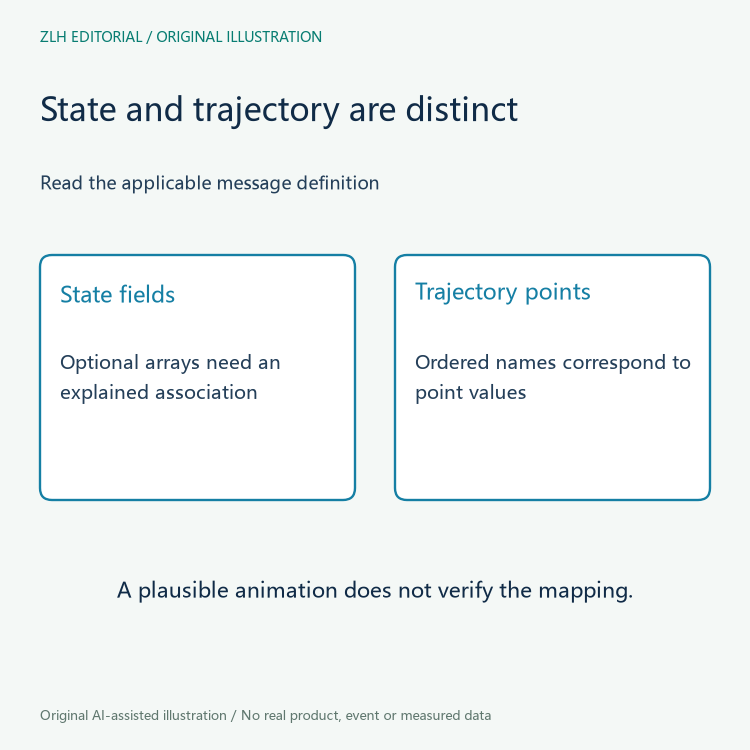
The official Jazzy JointState definition describes joint names and arrays for position, velocity, and effort. Its comments state that arrays should have the same size or be empty, allowing optional state fields while retaining the association with joint names.
A receiving checklist should therefore distinguish an intentionally empty optional field from a populated array whose association is unexplained. It should not fill missing values with invented zeros to make a table look regular. The supplier needs to explain what was actually provided and what the consumer is expected to infer.
The definition also gives the header time context for the states in one message. That is another part of the delivered meaning. The present article does not analyze timestamps or claim that a real recording meets the definition. It identifies the questions a supplier should be able to answer.
Keep trajectory ordering distinct from state presentation
The Jazzy JointTrajectory definition states that its ordered joint names correspond to the values in each trajectory point. The receiving team should retain that association rather than sort the names independently for a more attractive display.
Ask the supplier how any export or transformation preserves the intended mapping. Reordering a visible list without accounting for corresponding values can change interpretation. A handover should explain the actual transformation instead of assuming that alphabetical order is always the correct order.
This is a data-review question, not an instruction to execute a trajectory. A structurally understandable message does not establish that its contents are appropriate for a robot, a simulator configuration, or a particular task. Those claims require their own authorized review.
Request evidence at the association boundary
A later offline examination should identify the source record, the applicable message definition, and the mapping inspected. If an export introduces a new representation, ask which evidence shows that the name-to-value association was retained. A screenshot of the final table alone may leave the transformation unexplained.
Keep ambiguity visible. If a supplied list cannot be associated with the intended values, request clarification rather than choose an order that makes a visualization look plausible. A smooth animation is not evidence that the underlying mapping was correct.
The same discipline applies when a field is omitted. An absent observation should remain absent unless the source’s documented semantics justify another interpretation. A reviewer should not convert lack of data into a measured value or a completed motion state.
Preserve the accepted representation and its limits
The proposed acceptance note should make clear which representation was reviewed, which association rule applied, and what actual evidence supported the result. It should also state what remains outside scope, such as dynamic behavior, physical limits, or suitability for command use.
If the author changes the joint set, ordering, or export transformation, ask which previous observations need to be repeated. Preserve earlier source material with its original mapping. An unchanged lesson title should not imply that all underlying data relationships stayed unchanged.
More examples appear in our robot simulation section and the article directory. Both original illustrations show association questions only. They contain no actual joint identifiers, positions, velocities, recorded trajectories, control outputs, or completed simulation results.


