

Blender 5.2 Assets: A New Source for Robot Scene Reviews
2026-11-02
Blender 5.2 Assets: A New Source for Robot Scene Reviews
A robot scene can contain a model acquired from one source, materials from another, and additional content supplied with a learning project. Blender’s support for remotely hosted asset libraries makes the source of that content worth discussing in a scene review. The feature is part of the Blender 5.2 LTS release, whose official version page also records subsequent updates. This article checks those records on November 2, 2026, and considers a hypothetical scene-preparation task. It does not claim that Blender has validated a robot model or that an online library supplies physically accurate simulation inputs.
Read the feature alongside its release record
The Blender Foundation’s July 14, 2026 announcement says asset libraries support remote hosting, including access to the Blender Online Essentials library and the ability to host libraries. The official Blender 5.2 LTS page records the series and lists 5.2.3 on October 22, 2026. A feature announcement and a later version entry therefore carry different dates and purposes.
A scene report should identify the actual software release it discusses. Merely writing “the new Blender” would make the record ambiguous for a later reader. At the same time, the publication of an update does not show which release was used to prepare a particular scene. That needs evidence from the scene’s own working context.
Availability answers only the first content question
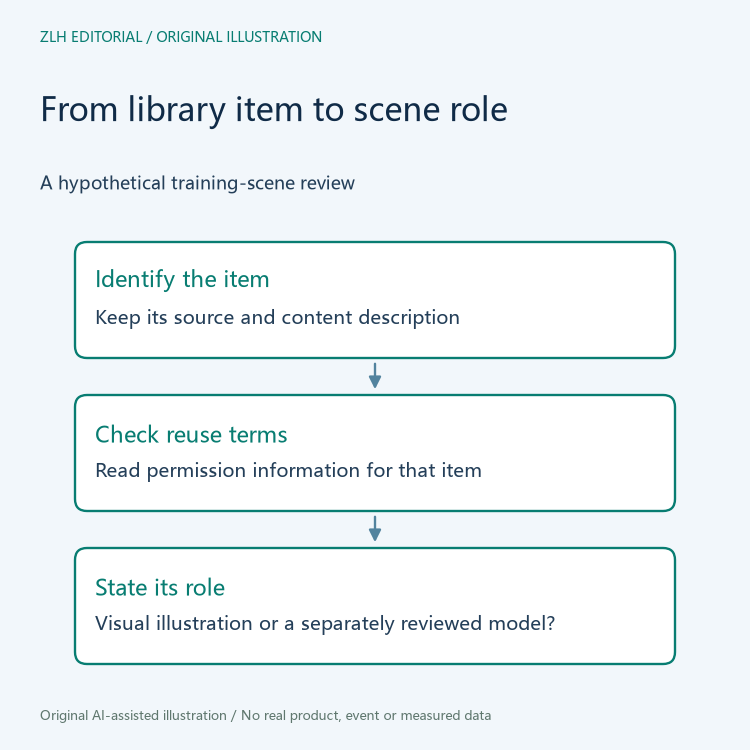
Imagine an explicitly hypothetical training scene in which an instructor wants a background workstation and a robot-shaped visual object. A remotely available item may help with scene preparation, but finding it does not answer every question about using it. The instructor still needs to know which item was selected and what the accompanying source information permits.
Keep availability, permission, and intended use as separate entries in the review. An item visible in a library is evidence of an available content source at that moment. It is not by itself a statement of the rights for every downstream use. The relevant permission must come from the material and license actually associated with that item.
The example does not assume that any named library contains such an object. It illustrates the questions a scene author should ask after encountering content. No asset has been downloaded or inspected for this article, and no third-party artwork appears in its illustrations.
A visual object needs a separate simulation decision
In the hypothetical exercise, the author might use a model simply to help learners recognize a scene element. A later exercise might ask a simulator to reason about physical behavior. Those tasks require different supporting information, so the author should decide the object’s role before presenting it to learners.
Do not infer a complete physical description from an attractive preview. If a task depends on particular geometry or other model properties, the responsible author should identify the evidence used for those properties and the scope of the review. A library’s hosting feature does not supply that judgment for an arbitrary object.
This distinction can be communicated without turning every introductory lesson into a full engineering validation exercise. A visual-only object can be labeled as such. A model intended for a more demanding task can remain pending until the required checks exist. Clear limits are more useful than a broad “simulation-ready” label with no stated meaning.
Record what belongs to the scene package
A collaborator receiving a scene needs to understand which content the handoff includes and which sources remain external. That should be explained in the actual delivery arrangement, rather than guessed from the fact that the original author could open the scene. An author’s own access conditions may not match those of the recipient.
For the proposed exercise, make a small content inventory with item identity, source reference, permission note, and intended scene role. These are editorial suggestions for the example, not new obligations attributed to Blender. The inventory should describe real selected content if the exercise is later carried out.

Explain the new option without claiming a finished pipeline
The release provides a new way to make asset libraries available. A useful robotics-oriented reading can connect that option to scene sourcing and collaboration questions. It should stop short of claiming that hosting alone guarantees reproducibility, redistribution rights, or physical validity.
If an instructor later runs a specific scene exercise, its observations can be added as a separate record with the actual files and environment. This article supplies no rendering benchmark, successful simulation run, or model-quality ranking. Its two original diagrams show only the review relationships described in the text.
Further discussion of scene preparation is available in our robot simulation learning section, with related topics in the article directory. The practical question raised by remote libraries is not just where an object can be found, but what evidence accompanies the object when someone uses it for a particular learning task.


