

Robot Animation Curves: Interpolation and Extrapolation
2026-11-05
Robot Animation Curves: Interpolation and Extrapolation
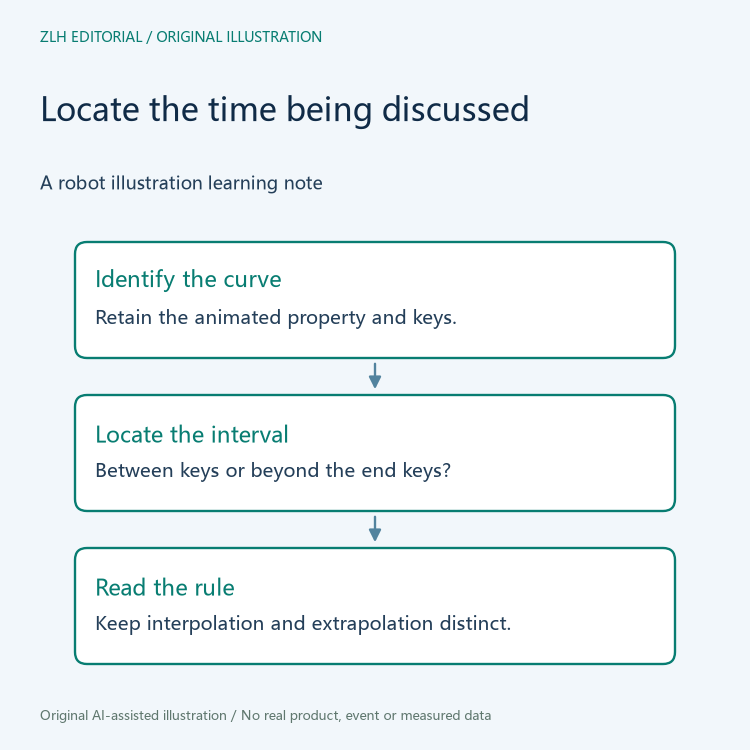
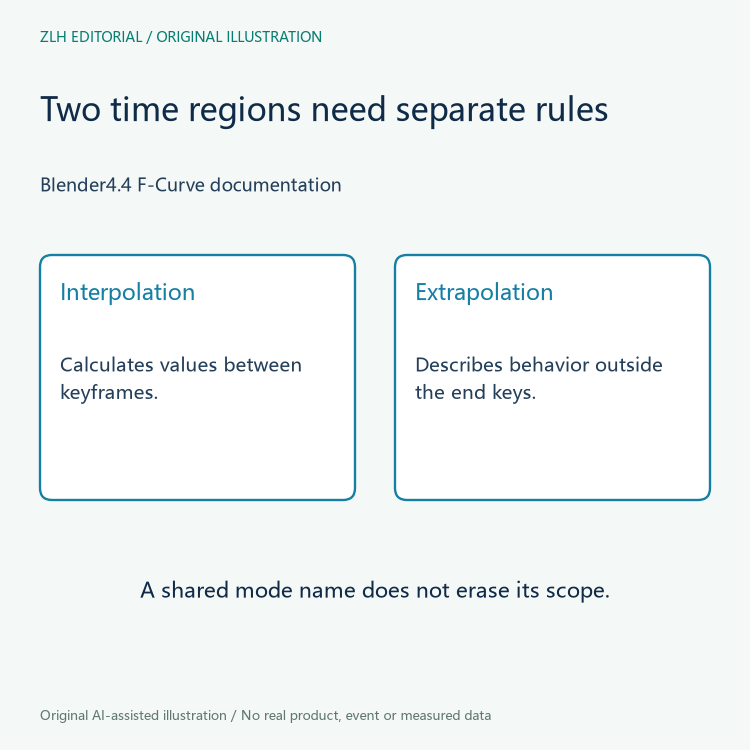
Animation Curves in a robot illustration lesson need a clear time scope. Interpolation describes values between keyframes, while extrapolation describes behavior before the first key and after the last. A mode name such as linear does not identify which of those questions the author is answering. This article reads Blender 4.4 documentation without editing a scene, playing an animation or sending motion to a robot.
Identify the property and its keyed interval
The official F-Curve introduction explains that a function curve describes how an animated property's value evolves over time. A robot illustration can use such curves for many scene properties. The curve's existence does not establish that it is a recording of a physical joint, tool or manufacturing cycle.
A learning note should name the property, the curve and the relevant keyframes before describing its behavior. If a screenshot crops away the first or last key, the reader may not know whether the displayed interval lies inside or outside the keyed region. The visible edge of a screenshot is not itself an animation endpoint; it may simply be the boundary of the contributor's current editor view. Preserve that context rather than infer it from the curve's apparent smoothness.
Read interpolation within the keyframe sequence
The introduction explains how a few keyed values allow the curve to calculate values at other frames. Its example illustrates values between two keys. This is the interpolation question: what value does the curve supply between the specified keyframes? It is a rule for the scene property, rather than an extra physical observation at every intervening frame.
A caption should retain that computed-value role. A learner may see a complete-looking line without seeing every key that defines it. The line alone does not show that each point was separately measured or explicitly keyed. This article has calculated no intermediate value and does not recommend an interpolation mode for an actual model.
Read extrapolation beyond the end keys
The official channel editing reference describes extrapolation as the curve's behavior before its first keyframe and after its last. That scope is distinct from the gaps between keys. A lesson discussing what happens after the final key should therefore identify the extrapolation account directly.
The reference describes constant extrapolation as retaining the first or last keyed value and linear extrapolation as continuing with the corresponding endpoint slope. These descriptions concern the curve outside its end keys. They should not be transferred into an unexplained claim about the whole animation or the robot's physical behavior.
Keep identical mode words attached to their scope
Words such as constant and linear can appear in animation explanations without identifying the time region. A reader needs both the mode and whether the author means interpolation or extrapolation. A linear-looking segment inside the keyed interval does not independently establish the rule beyond the last key.
Likewise, a constant region after the last key does not prove that the earlier interval used constant interpolation. The two descriptions can be kept in separate notes without fabricating additional keyframes. This is a documentation distinction, not a proposal to alter handles, extend an action or adjust the timing of a robot animation.
Review a fictional animation handout
Imagine a fictional learning handout whose caption says linear between keys, then claims that the curve necessarily continues linearly forever. The reviewer should ask for the endpoint extrapolation context and narrow the caption to the region actually explained. This invented example contains no delivered scene, frame values or actual animation result.
A second illustration might show a flat continuation after the final key and call the entire keyed sequence constant. The reader should distinguish the visible endpoint continuation from the behavior between earlier keys. The correct response is to recover the separate temporal scopes, rather than diagnose an error in an unknown Blender file.
Keep curve extension separate from repeated playback
The channel reference also describes making a curve cyclic through a Cycles modifier. Its presence would be additional context, rather than something this article assumes from an extrapolation word. A contributor should retain the actual curve and modifier account supplied with the lesson. This article has applied no modifier and reports no repeating result.
Both official pages were read on November 5, 2026. Their example graphics were reviewed as documentation; the original figures here contain no copied curve or fabricated physical trace. Related material appears in the robot 3D learning collection and article directory. Reading Animation Curves by their keyed interval and endpoint scope gives a learner a precise question before interpreting what an illustration declares.


